You Do Not Have Visibility. You Have Monitoring.
Ask ten integration teams if they can see their integrations. Ten say yes. Most of them mean one thing when they need four.
There is a word that has quietly grown too big for its job.
Monitoring.
Twenty years ago it meant something small and clear. You watched a few servers. You watched a handful of message queues. When a light went red, someone went and looked. That was the whole job, and the word fit it.
Then the systems multiplied. The platforms multiplied. The cloud arrived, then hybrid, then a partner running half your estate for you.
And the word “monitoring” was asked to stretch over all of it.
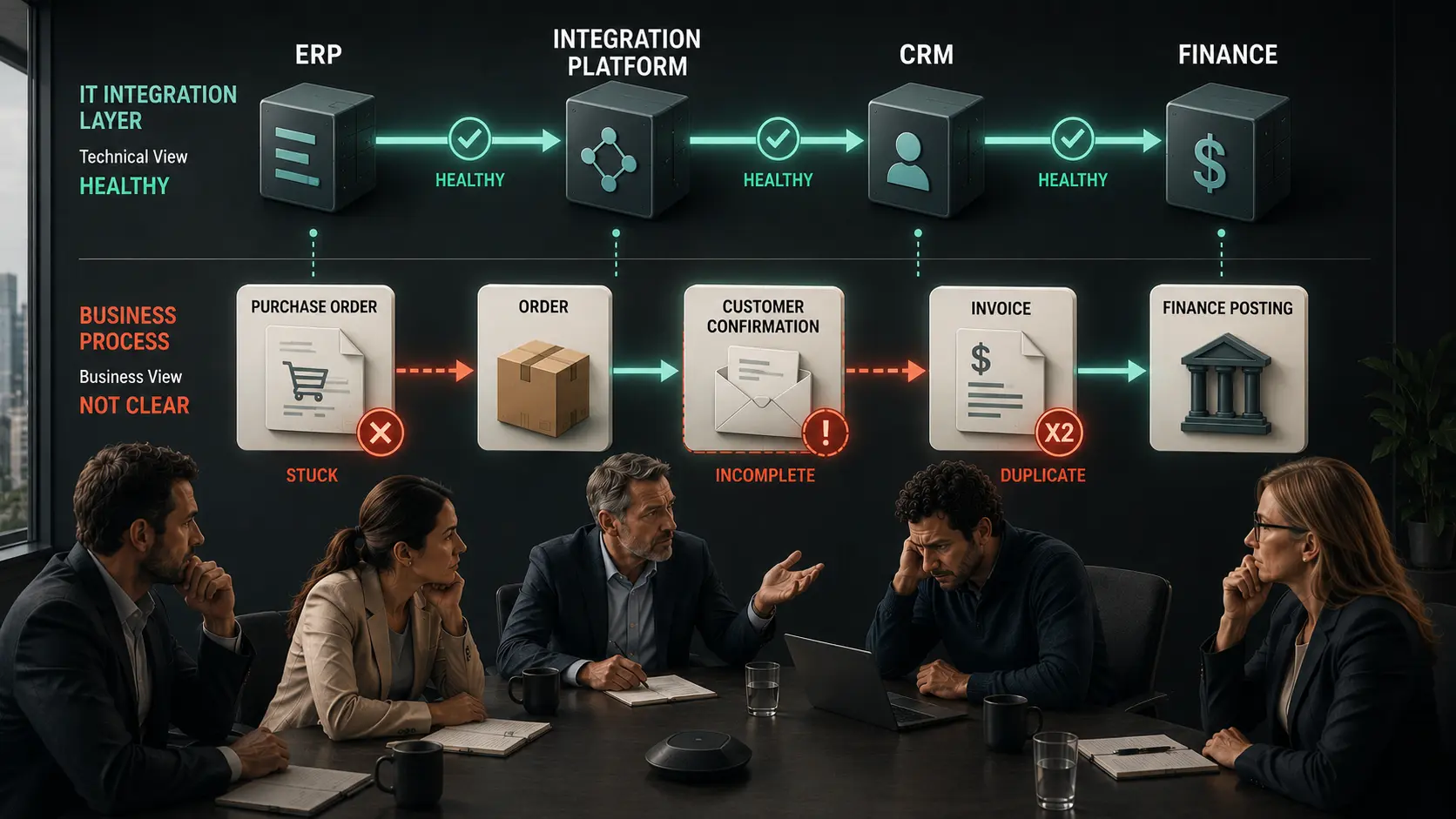
Today, when someone says “we monitor our integrations,” it is genuinely unclear what they mean.
Watching servers? Watching flows? Watching a business process end to end?
Different teams say the same word and picture different things.
That is the trap. Not a tool problem. A word problem.
The monitoring word-trap.
Here is what the word hides.
When you look closely at what an integration team actually needs to see, it is not one thing. It is four.
And “monitoring” only covers the first one.
Once you separate the four, a lot of budget arguments and vendor demos suddenly make sense.
You stop asking “do we have visibility, yes or no.”
You start asking “which of the four do we have, and which are we running blind on.”
Let me lay them out plainly.
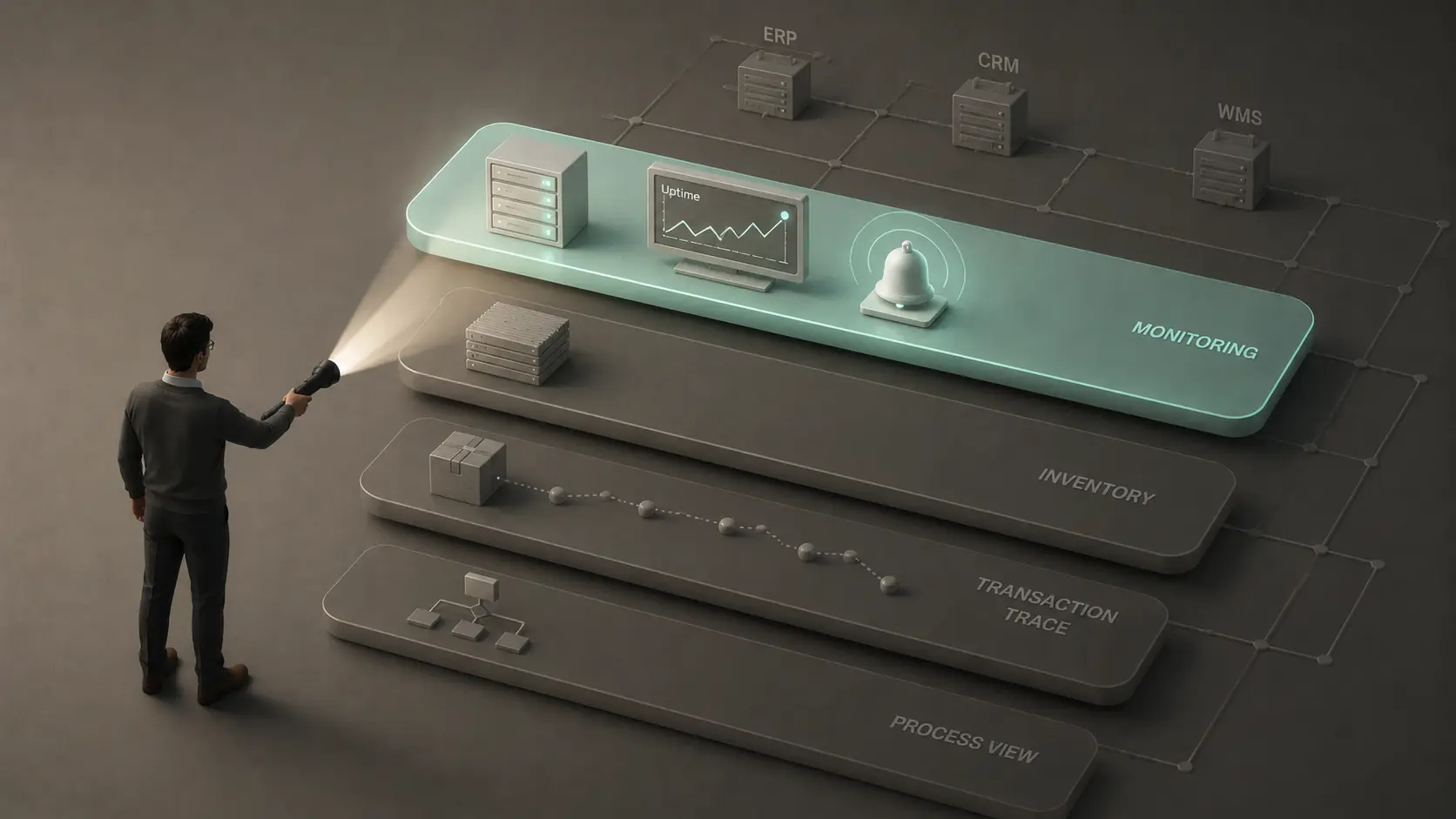
1. Layer one: See it run, See it break.
This is the layer everyone knows. Servers run. Services respond. Messages move. When something breaks, an alert fires and someone fixes it.
If you run an integration platform today, you almost certainly have this. It is the front door.
It is also reactive.
It tells you what just happened.
It does not tell you what you have, how the pieces connect, or what any of it means to the business. Those are three different questions. This layer answers none of them.
Most teams live here and quietly assume it is everything. For anything more than three connected systems, it is not.
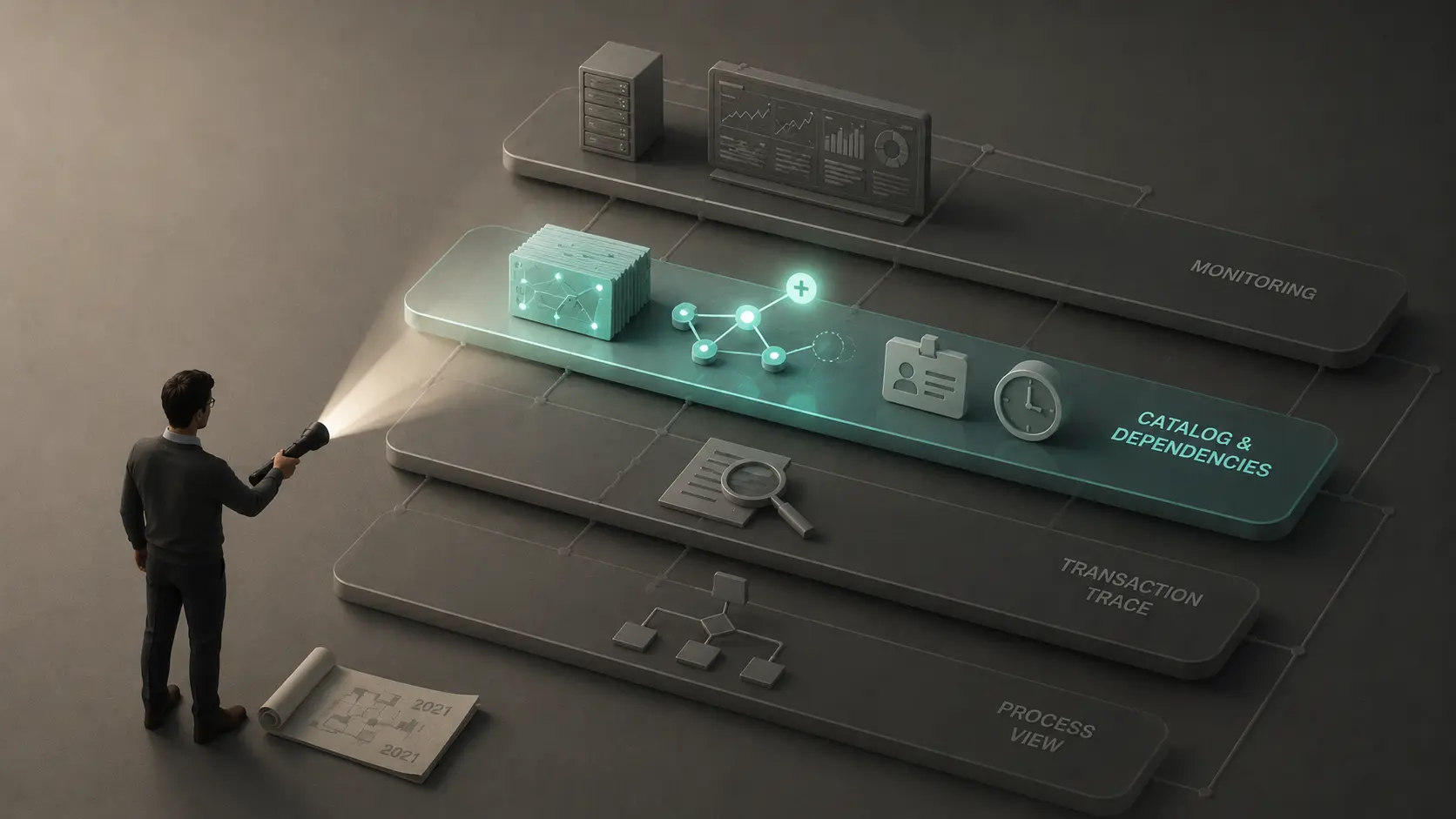
2. Layer two: See what you have.
Try this.
Right now, list every integration your organisation runs. Every endpoint. Every dependency. The owner and the service level for each.
How long would that take? An hour? A week? Three people in three teams comparing notes?
For most teams the honest answer sits somewhere between “we have a diagram from 2021” and “we would have to go and ask around.” That gap is layer two.
A live inventory answers one question: what do we actually have running.
Not what the old diagram says. What is there today. It updates itself.
It tells you when something new appears that nobody documented, and when something old goes silent.
The first time an architect walks into a redesign meeting with a live inventory instead of a stale drawing, the meeting changes. The decisions get sharper. The risk gets visible.
Most teams never turn this layer on. It is one of the highest-leverage things they never do.
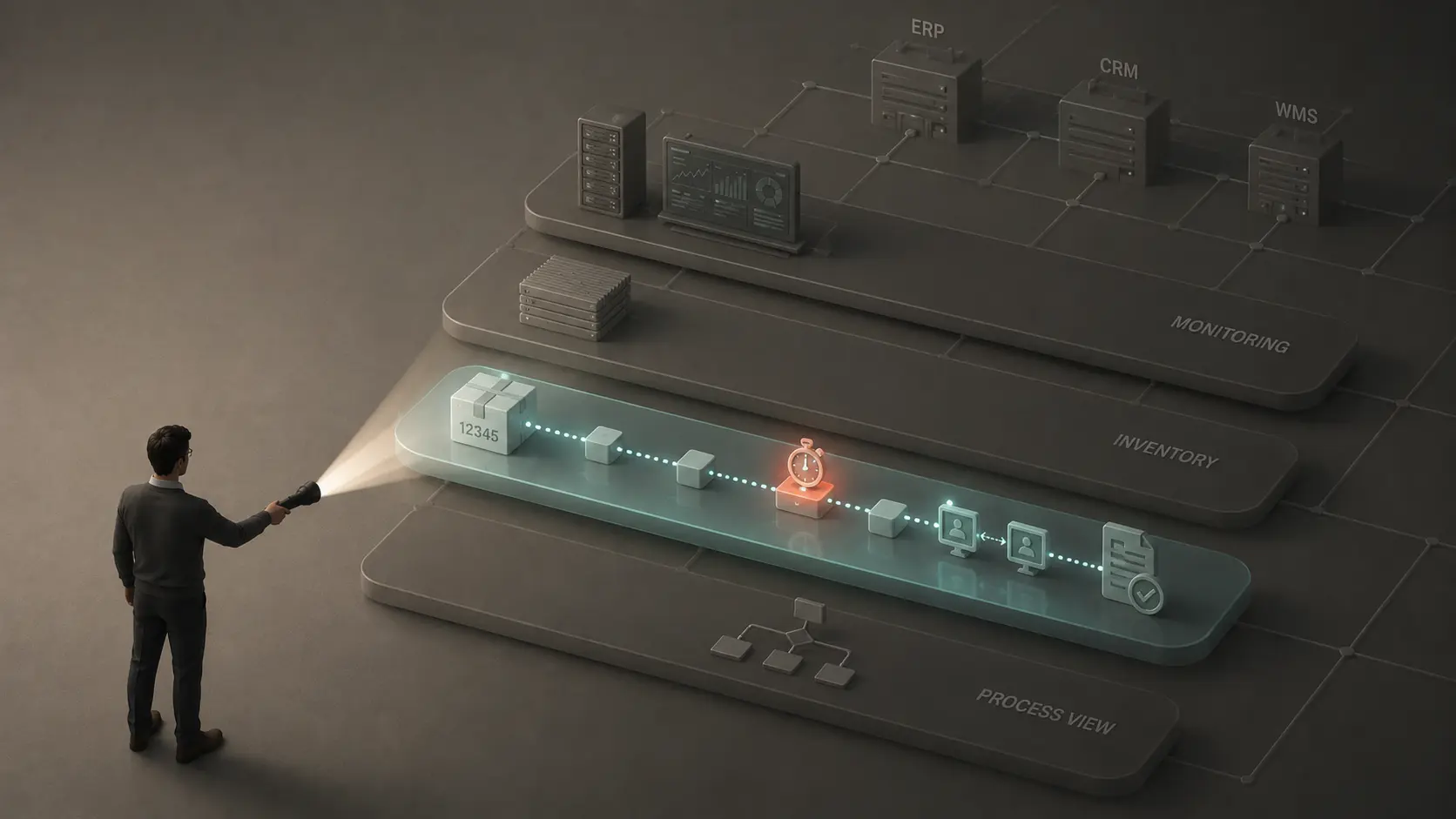
3. Layer three: See how it flows.
This is where the conversation stops being an IT conversation.
Layer three follows a business transaction across every system it touches.
Not “is the server up.” Not “is the API responding.” But “where is order number 12345 right now, and how long has it been stuck.”
Watch what changes.
The sales manager who used to phone IT about a missing order looks it up in two clicks.
The compliance officer who waited three days for an audit trail produces one on demand.
The business owner who argued about whether a process was “broken” now points at the actual step where it stalled.
The same picture is visible to both sides, in a language both sides understand.
IT stops being the black box that occasionally fails.
That is the layer that changes the relationship.
It is also the layer most often promised in a demo and least often delivered, because it needs the first two underneath it to be real.
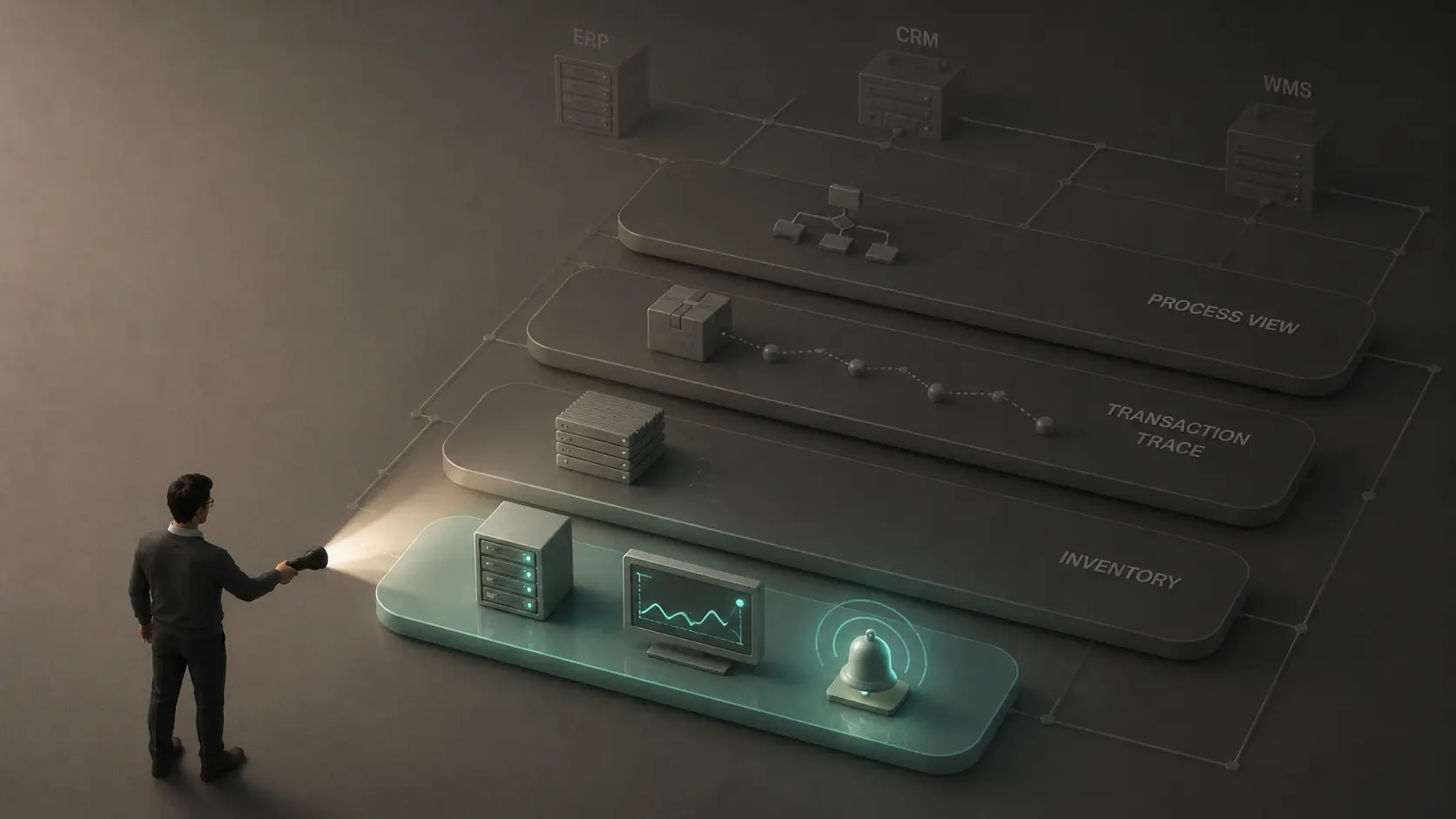
4. Layer four: See how it is built.
Every team has an architecture diagram somewhere. Drawn in Visio or PowerPoint.
Accurate the week it was drawn. Wrong six months later, because the landscape moved and the picture did not.
Layer four is what happens when the diagram and the reality stay in sync on their own.
A new endpoint appears, the picture knows. An old one dies, the picture updates.
You are not maintaining a slide.
You are reading a live map.
Almost nobody has this.
Not because it is impossible, but because doing it by hand is a job no one has time for.
Built on top of the first three layers, the cost changes. The diagram stops being a chore and becomes a way to navigate.
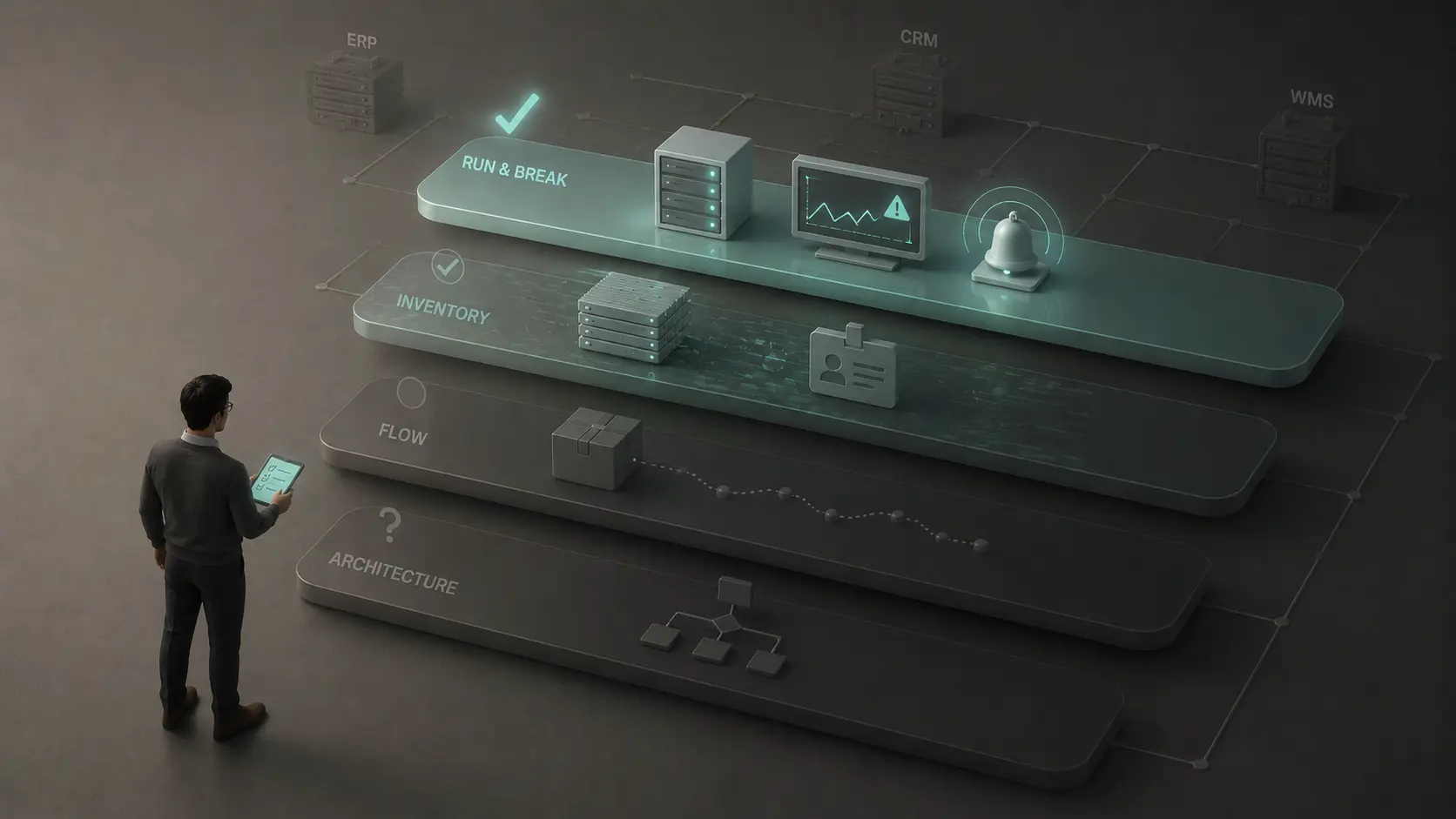
5. The Four-Layer Test.
You do not need a long audit to place yourself. Four questions do almost all the work. Answer each one honestly, yes or no.
1. Run and break: When a critical flow fails, do we find out from an alert, or from an angry phone call?
2. Inventory: Could we list every live integration, with owner and service level, in under an hour?
3. Flow: Can someone outside IT see where a single business transaction is stuck, without calling us?
4. Architecture: Does our architecture picture reflect reality this month, or the last reorg?
Most teams get a clear yes on one, a shaky yes on two, and a no on three and four.
That is not a failure. It is the normal starting point for the whole industry.
The value of the test is not the score.
It is that you can finally name the gap, and once you can name it you can decide whether to close it, when, and in what order.
The teams that close it fastest do not rebuild everything.
They pick one process. The one that breaks most, or matters most, or that compliance keeps asking about.
They work it up through the layers over a few weeks and use the result to prove the next one is worth doing.
Visibility compounds the same way money does.
One anchor from the field. At a large construction group, the same operational view is now read right across the business, most of its readers outside IT.

6. What you keep from this.
None of the four layers cares which platform you run.
Azure. On-premise. A hybrid estate.
One platform or four stitched together, mid-migration or steady.
The layers do not change with the logo on the dashboard. The order you activate them does, and the people involved, but not the map.
So the next time someone says “we have monitoring covered,” you have a better question than yes or no.
You have four. Run the test. Find the layer where you are blind. Start there, with one process, before the day a flow breaks in public and the conversation happens without you in the room.
That single answer will tell you more about your next architecture meeting than any status dashboard ever has.