You Are Not Migrating a Platform. You Are Migrating an Estate You Cannot See.
Migration budgets are often wrong, and not because finance can’t add up. They price the platform you can see. The real cost sits in the invisible estate you are moving from. For the IT director who has to defend the number.

The business case was clean. Licenses. Servers. The partner’s day rate. A line for testing and cutover. Finance trusted it because it sat neatly in a spreadsheet. You signed it because the numbers were real.
Then, around the fourth month, the number started to move.
An integration nobody had listed. A flow that depended on one person who had already half left. A rebuild estimate that grew the moment discovery actually finished. None of it was on the page. Now all of it needs explaining.
So here is the question worth asking out loud, before the next migration and not during it:
Why do migration budgets always move in month four?
The easy answer is that the estimate was sloppy. It usually wasn’t. The model was answering the wrong question.

1. You priced the platform. The cost lives in the estate.
Here is the reframe. The rest follows from it.
A migration budget prices the thing you are moving to. A target platform. Its licenses. Its infrastructure. The labor to stand it up. That part is easy to count, which is exactly why it fills the spreadsheet.
But you are not moving a platform. You are moving an estate.
By that definition we are referring to ALL aspects of integration architecture, governance and expertise.
Every integration. Every scheduled job. Every quiet point-to-point flow that has kept the business running for fifteen years.
Plus the people who understand them.
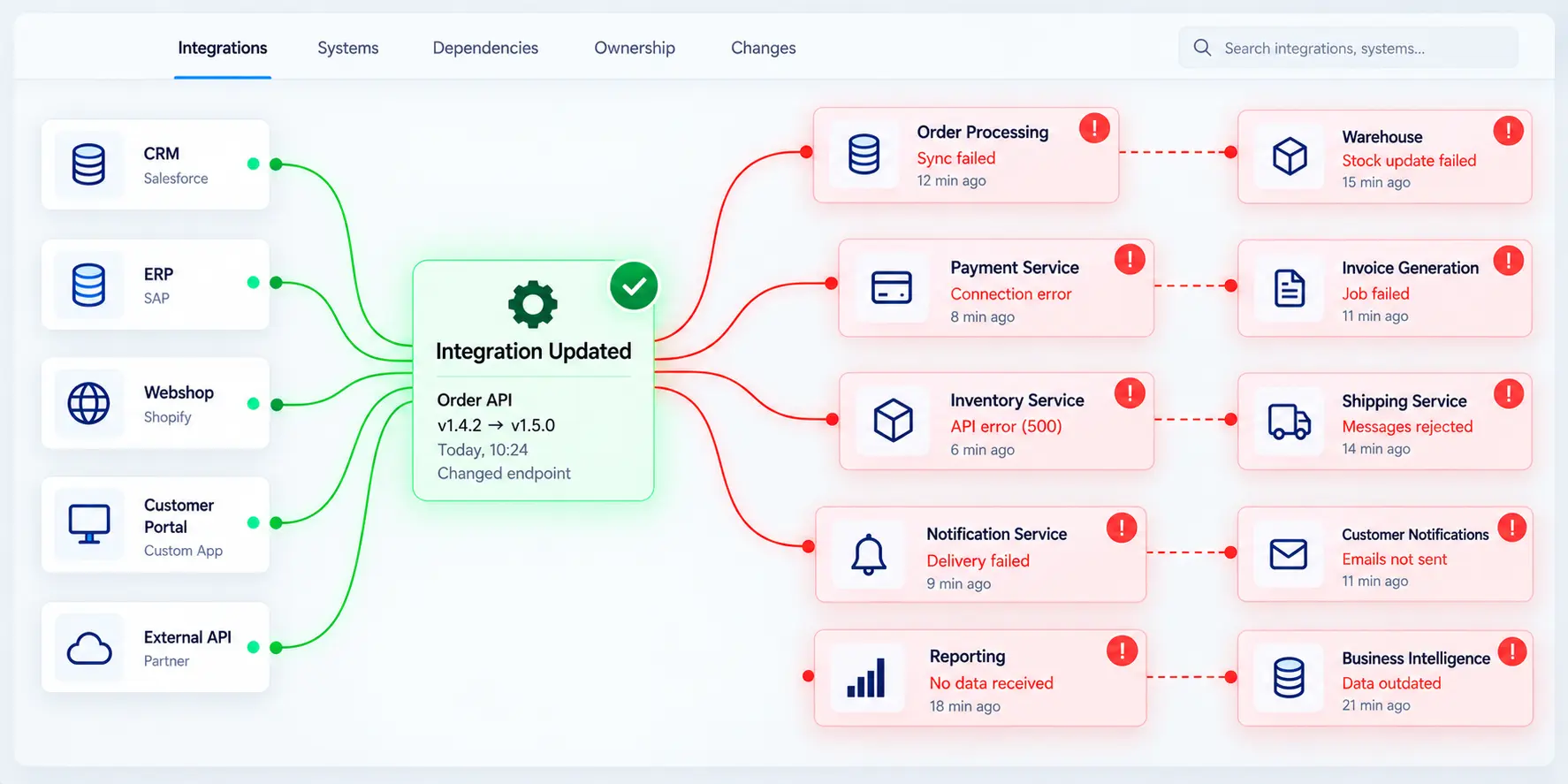
Much of that estate is invisible. It is not in the CMDB. Not in the repository. Not in the business case.
That is the gap.
The budget is built on the visible half and asked to cover the whole.
Call it the invisible estate: the part of what you are moving that never shows up on a balance sheet and does not travel with the system.
The budget moves in month four because that is when the invisible estate finally shows up.
And the only way to stop the surprise is to see it first.
That starts with one move: find your real integration count.

2. Half of it is flows you can’t see.
Every cost in a migration multiplies by the number of integrations you actually have to move.
Read that again.
Discovery is priced per integration. Rebuild is priced per integration. Testing is priced per integration. So your integration count is the single most leveraged number in the whole model.
And the documented count is the floor, not the reality.
The undocumented flows are the ones that never made the list.
The connector quietly feeding finance every night. The job nobody owns.
In the models we work with, the real total often runs somewhere between 1.4 and 2 times the documented count.
Do the math on that. If the real count is close to double the documented one, and everything is priced per integration, the migration is not slightly over.
It was mis-scoped from the first line.
Which is why the first job is not to estimate harder. It is to find your real integration count.

3. Half of it is people you can’t replace.
The second half is harder to look at, because it isn’t a line item. It’s a person.
The deep knowledge of a critical flow often lives with one senior specialist. Sometimes internal. Sometimes at a partner. Often close to retirement.
That is a cost while they are still at their desk, because it caps how fast you can safely move.
And it is a risk that grows quietly, because that generation of specialists moves on a little more each year.
The knowledge that used to be free becomes a premium day rate the day it walks out.
The longer you wait, the more you are betting it is still there when you finally need it.
This half rarely arrives as an invoice. It arrives as a flow nobody can safely touch.
And you cannot name that risk until you know which flows exist in the first place, which again means: find your real integration count.

4. Staying still is not a flat line.
There is a comfortable belief that “wait a year” is the cheap option.
It gets modeled as a flat line. This year’s support cost, repeated next year. That is not how it goes.
As a platform moves past its supported window, the price bends upward.
Extended support tiers. Premium uplifts. Year-over-year increases that compound instead of hold. This is not a single cliff on a fixed date. It is pressure that builds.
Compliance adds to it. A legacy layer that was never built for NIS2, DORA, or GDPR carries a quiet tax: remediation every audit cycle, plus the manual work to assemble evidence a modern setup would produce on its own.
So “stay” is not frozen. A comparison that draws it flat is quietly tilted toward waiting. To see the real slope, you have to know what you are actually running, which starts with your real integration count.

5. Every path pays the same taxes.
Here is the part that surprises people. It is also what makes this a fair model instead of an argument.
The hidden costs do not point to a destination. They apply to every path.
– Stay, and the weight sits on renewal costs and knowledge walking out the door.
– Move to the cloud, any cloud, and it shifts toward migration scope driven by that hidden integration count, plus retraining.
– Move to on-premise or containers, and it shifts toward platform and operating-model investment.
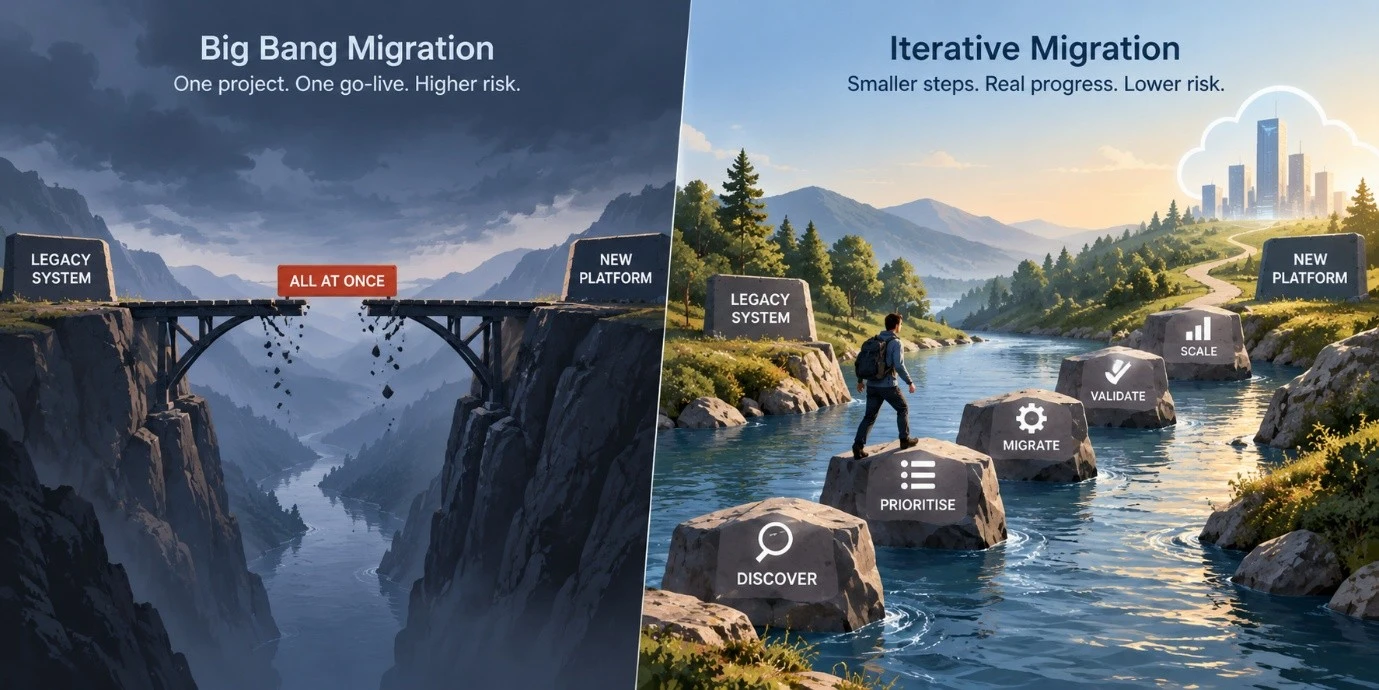
– Go hybrid, the realistic answer for most estates above fifty integrations, and you carry a little of all of it.
The categories stay constant. Only the weights move. That is exactly what makes them a fair basis for comparison instead of a thumb on the scale.
A model worth trusting gives you a blank recommendation until you put your own numbers in.
Your data drives the decision. Not a vendor’s roadmap. Not a date on a slide.
And the number that changes every weight is the same one, on every path: your real integration count.

6. The cheapest risk reduction in the whole project.
You do not need a perfect number. You need an honest one, with a visible range instead of a single point, and the standing to defend it.
Almost all of that rests on one move you can start this month.
Find your real integration count.
Treat the documented list as a starting point, not the truth. Then go hunt the flows nobody wrote down: the nightly connector, the ownerless job, the script that has run untouched for years.
Turning a guessed count into a known one is the cheapest risk reduction in the whole exercise, and it is worth doing before the migration, not after.
You do not need a new platform to do it. The evidence already lives in the systems your team runs today. The discipline is deciding to surface it before finance asks, not during month four.
One anchor from the field.
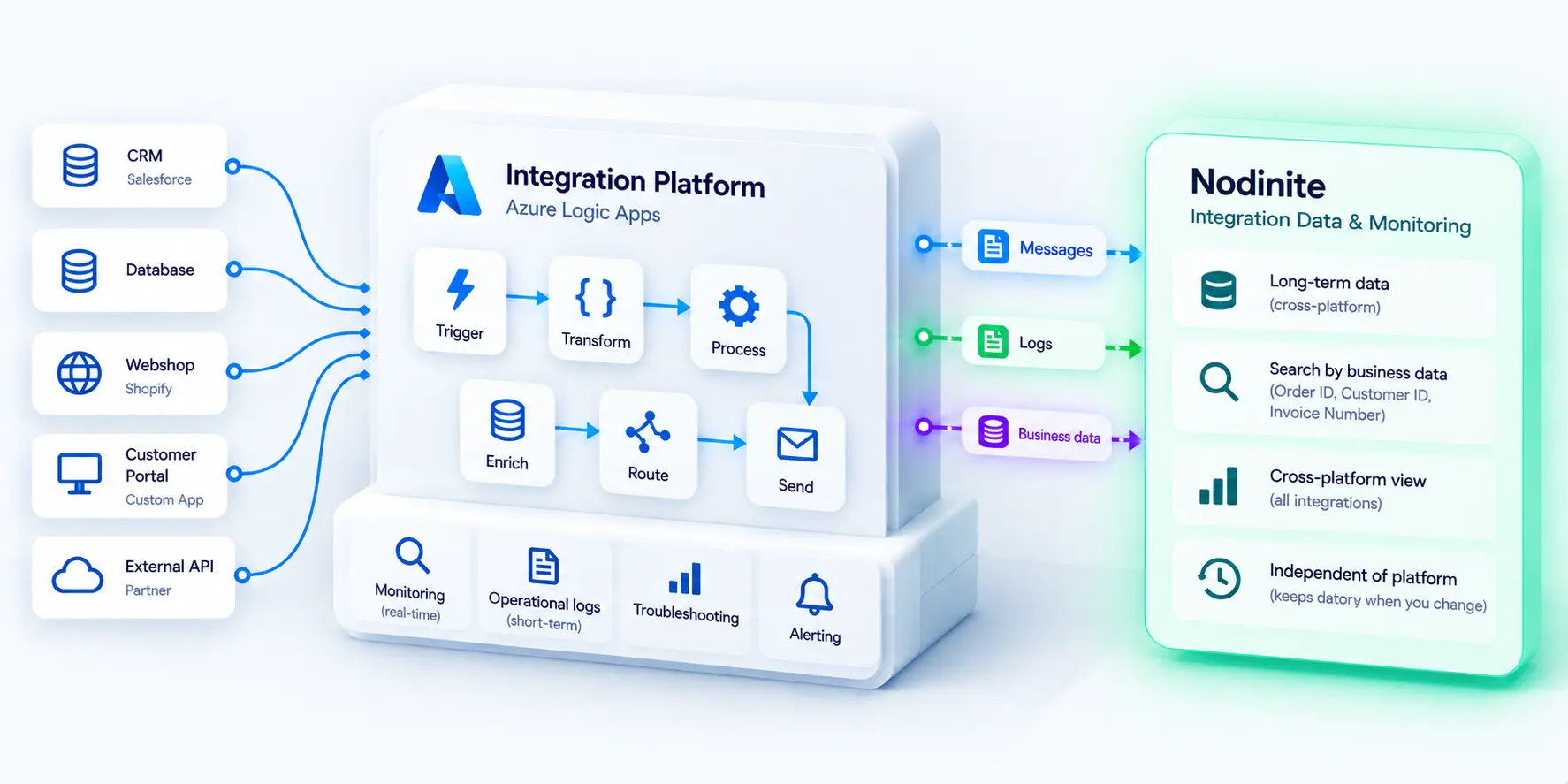
At a large Nordic industrial operator, the integration team handles more than 400,000 messages a quarter. Once they made that estate visible and counted, putting the right operating model in place paid for itself within three to four months.
The platform did not save them the money. Seeing the estate did.
Same lesson, whatever you run on. Azure. On-premise. Hybrid. A partner running it for you. The stack is your choice.
Counting the estate is the part that moves the budget.

7. You are not asking for a favour.
So go back to that business case, and the number that moved in month four.
You were never bad at estimating. You were handed a model that counts only the half it can see.
Here is the line, drawn plainly. There are two kinds of IT directors in a migration.
One brings the board the clean, visible number, and is back six months later explaining why it moved.
The other brings a range, names the invisible estate out loud, and is trusted precisely because the number has already survived the hard questions before the board asks them.
The first looks more confident on the day. And will keep losing the month-four conversation. The second has ended it.
You do not need to fight harder for the budget. You need to make the invisible estate visible before it makes itself visible for you.
Start with one move.
Before you price anything, find your real integration count, undocumented flows included.
That single number will tell you more about your next migration than any platform quote ever will.
Have you found your real integration count to be higher than the documented one? That gap is usually where the month-four surprise was hiding all along.