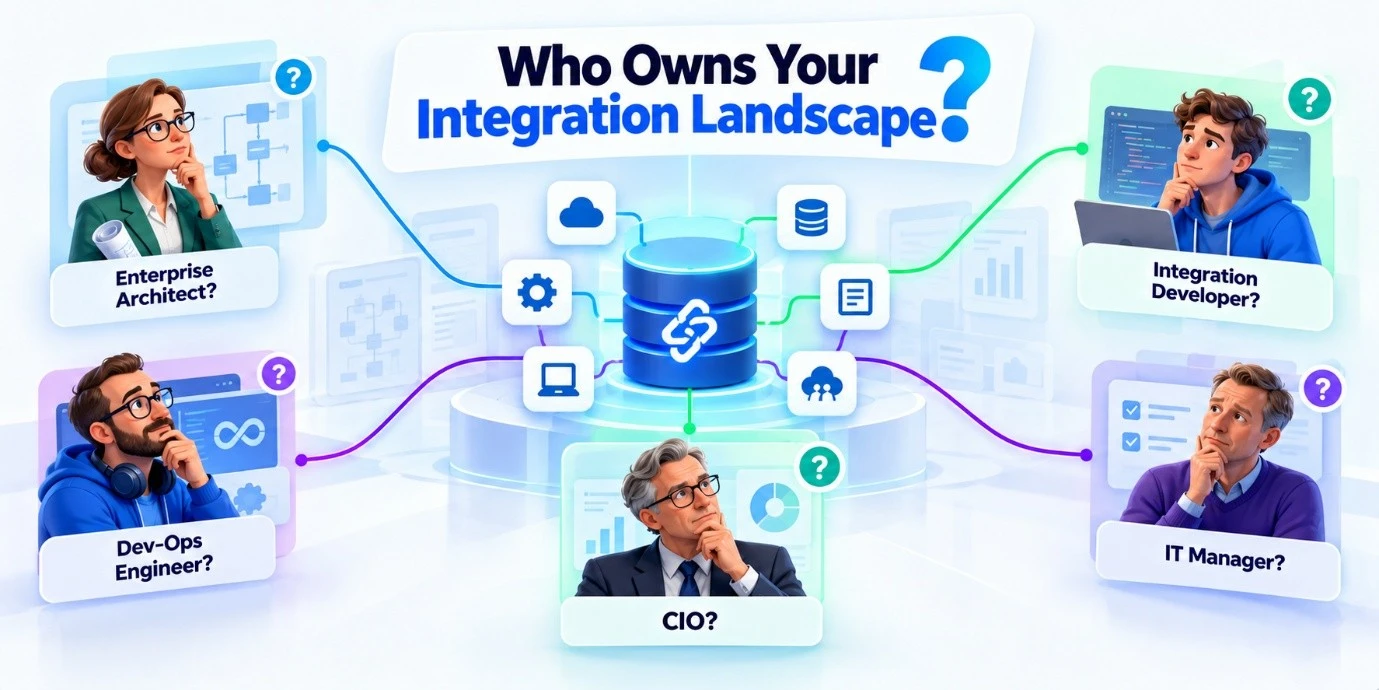
Who Owns Your Integration Landscape?
Many organisations have integration documentation spread across spreadsheets, wikis and diagrams. The real question is: who owns it?
This is not only a documentation problem. It is also a question of ownership. Someone may already have created a spreadsheet, a wiki page or a diagram of the integration landscape. But if nobody is responsible for keeping it current, it is not really an inventory. It is a snapshot of how things looked the last time someone updated it.
The problem can remain invisible for a long time. Integrations continue to run, projects move forward and nobody raises an issue. Then an integration fails, an audit begins, or someone asks a simple question: What do we have, what does it cost, and who is responsible for it?
Suddenly, the lack of ownership becomes very visible.
What we see at Nodinite
Recent Nodinite customer research highlighted this surprisingly clearly. Our interviews raised a recurring question about internal ownership and customers struggling to maintain value from their integration landscape. Yet it was largely invisible in traditional satisfaction scores.
One architect told us: “I’ve never even seen the system at my company.” Another simply said: “Nobody really owned it,” when asked which version they were running.
That is an important distinction. Having technology in place is not the same as having someone accountable for it.
For organisations using Nodinite, establishing ownership does not need to become another IT project. The integration inventory can provide a natural place to make responsibility visible and keep it current.
Start with three fields
You do not need a complicated governance model to get started. Begin with three things:
Integration. Responsible team. Last reviewed.
Then keep them current.
A useful question to ask your team this week is:
For each critical integration, do we know which team is responsible and who checks that this information stays current?
If the answer is unclear, you have probably found something worth fixing.
Learn more here: Repository Model: Living Integration Intelligence.