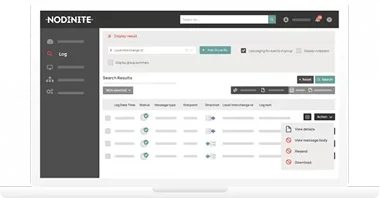
Has my order been sent?
Key evaluation criteria 1
Did the order arrive ok?
Key evaluation criteria 2
Are my APIs healthy?
Key evaluation criteria 3
About the customer
The customer is a well-known Swedish clothing retailer with stores across the country. As part of a restructuring effort, they established their own IT infrastructure, selecting Microsoft Azure as the integration platform and implementing a new D365 tenant.

Faster Troubleshooting

Centralized Monitoring

Full Control
The Challenge: Monitoring breadth, routing insight to owners, and staying maintainable as integrations grow

The retailer’s integrations spanned multiple transport types and connected both internal systems and external third parties. They needed to answer three key questions:
- How to monitor the full breadth of the new integration platform with configurable distribution of information?
- How to ensure data-flow insight reaches the correct business owner and/or support personnel easily?
- How to ensure the monitoring solution can grow and stay maintainable as new integrations and alert types are added?
Integration technologies involved
- Azure Integration Services
- Dynamics 365
- FTP/SFTP/File share
The Solution: Configurable end-to-end monitoring + metadata-driven notifications and “Log Views”
Nodinite was implemented to monitor exceptions and abnormal behavior across the integration landscape, then notify or alert the relevant party based on configurable rules. Notifications are largely routed to the maintenance system, while selected notifications go directly to “superusers” who can handle certain issues themselves.
A key enabler was metadata-driven configuration—including dynamic links that take users from the notification straight to the correct detail in Nodinite (or an external system).
To support day-to-day questions and investigations, the retailer built an integration query library in Nodinite using “Log Views.” Over time, this library grew from simple user requests into reusable outcomes of real incident investigations.
Example “Log Views” business questions include:
- Has my order been sent / accepted / updated by the 3rd party?
- Is my on-prem database healthy? Did nightly jobs complete? How many records were inserted?
- Have files been processed on FTP/SFTP/fileshares?
- Do we have Service Bus dead-letters? Are APIs healthy?
Results: Business visibility, smarter ownership, and continuous tuning of processes
With Nodinite in place, business users gained full visibility into data flows between systems. This allows them to handle non-integration issues themselves. While critical integration problems are automatically alerted to the right IT specialist for efficient resolution.
The retailer could monitor exceptions and abnormal behavior across the landscape, routing notifications either into the maintenance system or directly to superusers, depending on ownership and responsibility. This visibility also enabled continuous tuning of processes and automation to eliminate recurring issues and repetitive manual tasks.
Finally, the growing library of Log Views improved everyday operational responsiveness, supporting both ad-hoc “where is my order?” questions and structured exception investigations that help build towards broader data-flow insight (including “data fabric” ambitions).
Number of integration technologies
5+
Benefit: Visibility of processes and data flows
How does
Nodinite work?
Let us show you how Nodinite can create value for you from the first day. Start your free trial today.
- Monitor all exceptions
- Alert the relevant party
- Configurable notifications