What a Missing Exchange Rate Costs
Suppose an international company sells for millions of euros every day. One morning the day’s exchange rates are never loaded. Nothing crashes. An invoice goes out at the wrong rate, the customer rejects it, and the payment comes three days late. Three days of interest on amounts like that is real money. Every monitor was green the whole time.
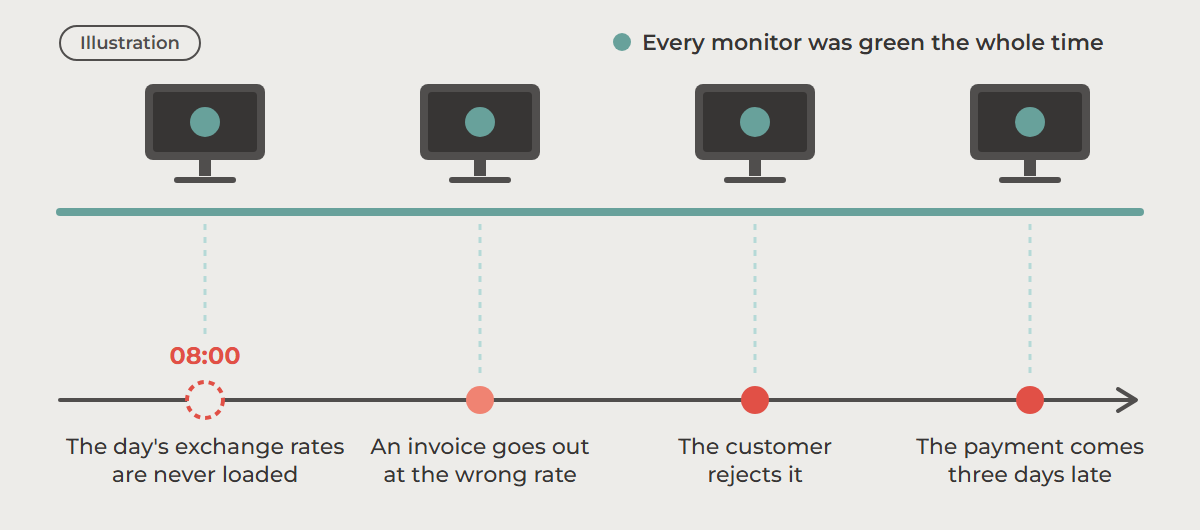
An illustration, not a real case: every monitor stayed green while a missing exchange rate cost three days of payment.
I have seen customers put the saving from checks like these at millions of euros a year.
Then there is the cost that never shows on an invoice. A fault like this is hard to find when nothing tracks it. You pull people in from several teams to work out what should have happened, and the hours go. For those of us who run integrations, that is the part we feel most.
Green is not the same as right
Most monitoring tells you when something failed. In the example nothing failed, so nothing alerted, and the business paid anyway.
That is a non-event: the thing that should have happened and did not, or did not happen the way it should.
Things must run. That is the technical side. Things must also be right, and the business pays when they are not. So a non-event is a business matter as much as a technical one.
Seven kinds of non-events
Each kind below comes with a question you can ask of a flow. Start with these seven; there are more. The examples are made up, to make each kind concrete.
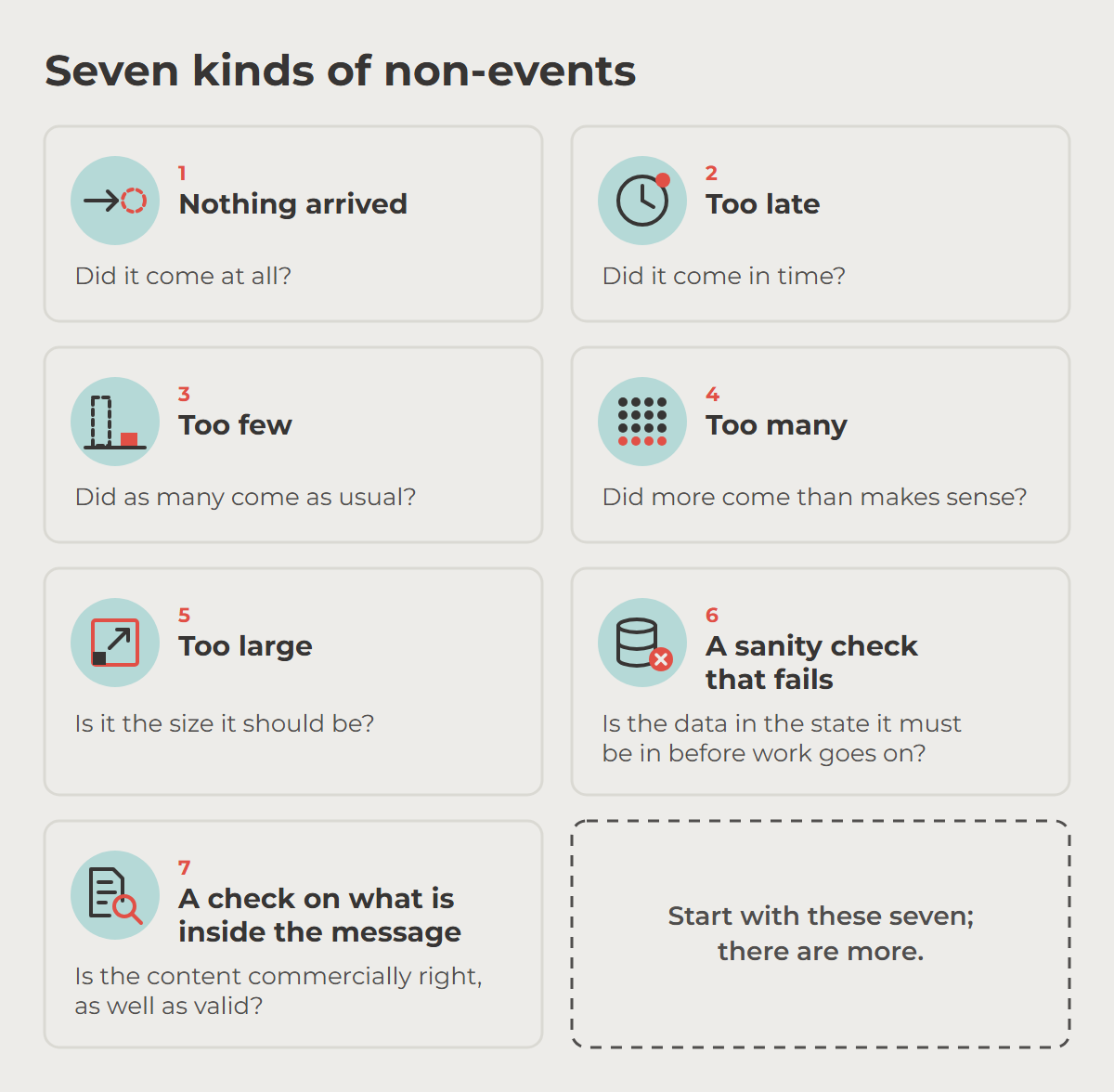
Seven kinds of non-events, each one a question you can ask of a flow.
- Nothing arrived. On a Friday at 14:00 the orders from the web shop stop coming. Every system shows green, because nothing has failed.
- Too late. The payment file reaches the bank after the cut-off. Suppliers are paid a day late.
- Too few. A retail chain normally sends about 400 orders an hour on a weekday. Today it has sent 40.
- Too many. 50,000 messages where 500 are normal. A loop is sending the same invoices again.
- Too large. A 100 MB message where 200 KB is normal. Someone sent the whole register instead of today’s changes, and it blocks the queue for everything behind it.
- A sanity check that fails. Today’s exchange rates were not loaded by 08:00, so invoices go out at yesterday’s rate.
- A check on what is inside the message. An order with quantity zero, or an invoice with no due date. Technically valid, commercially wrong.
The thresholds are examples too. Set your own from what is normal for each flow.
Many ways to do it, one benefit
How you check matters less than whether you check. You can build the checks yourself or use a monitoring product. The benefit is the same: you hear about the missing thing before the business does.
If you have these checks, and if you do not
Checks like these are easy to forget once you run them, because they work. Nobody notices the invoice that went out at the right rate. Their value shows the day they are gone.
No checks yet? Pick one kind from the list and one flow. Start small.
Either way, a check catches the problem while it is still cheap.
There is a gain for you as well. Describe a check by the business outcome it protects, and the business understands the argument. When you ask for time or budget, name the invoice or the payment the check protects. If your manager needs one line for the CIO, this one works: “We check that our integrations run, and we check that what the business depends on actually happened.”
Take the check away tomorrow
If one of your checks disappeared tomorrow, where would you start losing money first?
If you can answer that quickly, the check is worth protecting. If you cannot answer it at all, you have found where to start.
This week, pick your three most business-critical flows and write down, for each, what should have happened by when.
The seven kinds come from thirty years of working with integrations. When I was responsible for integrations myself, I found these checks fiddly to do, and that is why I built this into Nodinite. It is the product I would have wanted in that job.
Michael Olsson, Nodinite